Dadaism was an international, anti-system artistic response to World War I (1914-1918) that rejects coherence, authority, and the idea that culture is morally stable or redemptive. In simple terms, the movement exposes the instability of meaning and the authority of cultural systems.
Dada and Dadaism
“There is no ultimate truth… Does anyone think that, by a minute of refinement of logic, they have demonstrated the truth and established the correctness of their opinions? … I detest greasy objectivity, and harmony, the science that finds everything in order… I am against systems; the most acceptable system is on principle to have none.”
Tristan Tzara, “Manifeste Dada,” 1918 (Translation)
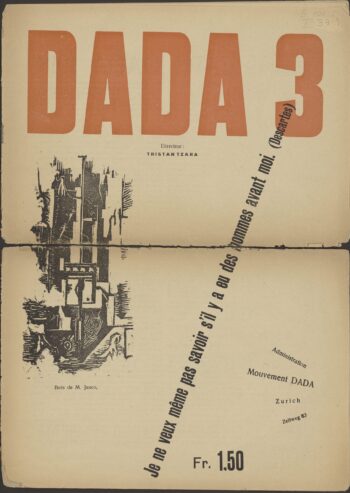
Kunsthaus Zürich, Library, DADA III:33:3, 1918. Image courtesy of Kunsthaus Zurich
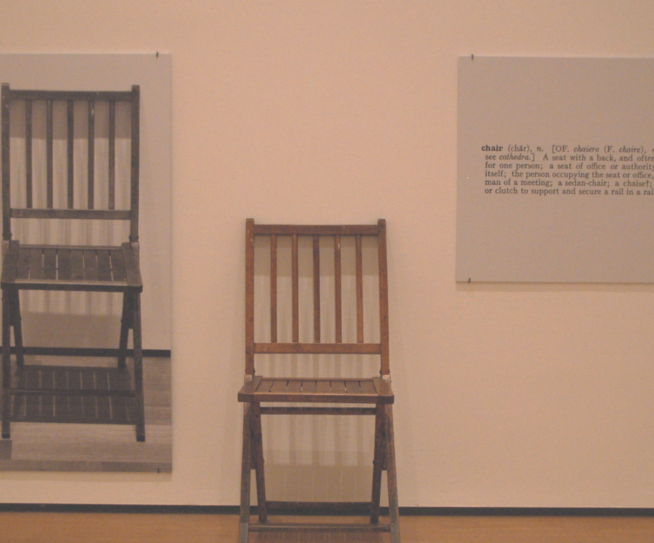
Joseph Kosuth, One and Three Chairs, 1965. Courtesy of MoMA.
Anti-Art
Anti-art and the “readymade” are branches of Dadaism as a result of further cultural critique. Anti-art refuses to adhere to the traditional claims of beauty as set by the Renaissance; beautiful art must be masterful and morally uplifting. According to systemic ideals, objectively non-beautiful works have an absence of true art. This shows how as humans there is a desire for the beautiful and how the appeal of the beautiful tends to prevail over contextual matter the more weight the culture gives in to it. The “readymade” is a rejection of objective meaning and the slippery nature of human definitions; an ordinary, mass-produced object designed as art through choice and context, rather than through transformation or craft. A thought experiment and conceptual piece that displays this philosophy well is One and Three Chairs by Joseph Kosuth. Kosuth displays a definition, image, and physical object of a chair.
This highlights the relationships between language, picture, and reference. Key artworks that encapsulate Dadaism, Anti-Art, the readymade, and cultural critique are from Marcel Duchamp’s archive.
Institutional Critique
Marcel Duchamp (1887-1965) was a French American artist that is most notably known for Fountain, 1917. Duchamp had submitted this piece to the Society of Independent Artists in New York and had been rejected. The piece was a porcelain urinal from a local plumbing store spun upside-down. The voting members of the society had rejected the piece, sparking controversy as the society had claimed to accept artists, despite background, a chance to display their work no matter what.
This begs the question, “who decides what art is?” and “what makes [them] a qualified surveyor?” Dada art is a pivotal movement because it is provocative of why there is no one single, authoritative answer. Artists, institutions, scholarly experts, the marketplace, and the public will all hesitate to define with certainty the answers to these questions. This anti-systemic movement speaks to how art is defined by the curators of these spaces, and not simply the individual curators of institutions, but us as curators of society. Every individual plays a role in society, and the Dada movement tests the habituation of our nature and why we contribute to the systems we do and why we should maybe reject some of them.
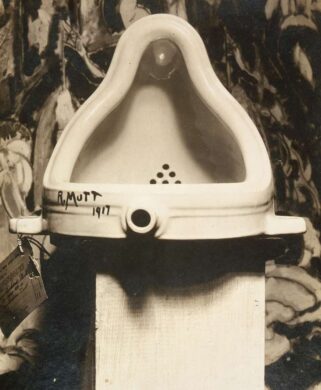
Marcel Duchamp, Fountain, 1917, photographed by Alfred Stieglitz at 291 art gallery following the 1917 Society of Independent Artists exhibit.