Francks Décéus
Throughout his artistic career, Francks F. Décéus has studied printmaking, collage, and painting, his work having developed through the lens of a childhood in Haiti, into his new urban community as an immigrant, and recently, to his meditations on a conceptual vision of humanity. He has always been more interested in exploring themes and issues than in making definitive statements or creating a visual language with his art, and his work resonates with political and sociological content.
Décéus's modernist style combines figurative, abstract, and layered elements and relies heavily on a simplification of form and function. His work is characterized by a semiotic economy, minimalist use of imagery, and a deliberately limited palette range within a series of works.
Sofia Minutoli: Walk me through a typical day of your life in the studio? What sort of goes on when you get in here? What's your process in the mornings and then throughout the day?
Francks F. Décéus: My process on an average day starts with getting some news. It's usually like NPR or Democracy Now or PBS. I was trying to get some kind of, you know, objective views on what's going on. A lot of my days start with some news feeds. It’s good to be engaged with current events from an earnest point of view. Then coffee, breakfast, and by noon or so, I start making my way to the studio. I bike, as well, when I can, weather permitting. And there's a way of staying fit-ish and getting my cardio, because the studio practice can take its toll on you physically. And so I try to find some kind of physical activity or exercise that gives me the stamina when I come here, to stand, walk around, and move stuff around for hours, and not be destroyed by it physically.
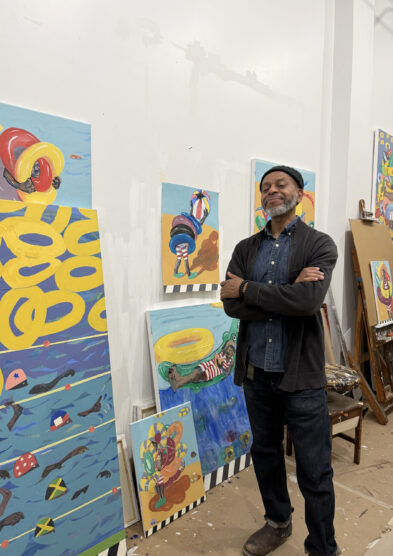
Francks in his studio, 2026. Photo by Sofia Minutoli.
So I walk in the door, I usually listen to some music, sit for a while, look at what I was working on, and look at what I've I've already done. I also look to see how it's all sitting, sitting with the same level of conviction when I first created it. Artists get this excitement at the completion of a piece, and that excitement sometimes just thwarts the consistency of the piece and the consistency of the trajectory. The trajectory is always kind of changing anyway, but can it work? That's the question that I sit with for a while, then I'm looking for edits in the work. Asking: What do I like? What do I not like? What can I change? What can I change? What am I stuck with? Do I have to scrap it and start all over again? And that happens quite often, because there's a certain confidence that comes with certain pieces that is not always obvious in every other. For me, it's important that I stick with the message, the thing that actually drew me to that conclusion in the first place. That thing is always changing, you know? But it's a personal thing, it's a self-identifiable thing. It's an intuitive thing. After 20 years of doing this, I've come to trust that “thing,” you know, whether that thing is. You know, it's pretty much been a lot of self-trust and self-exploration and self-investigation; trying to reinterpret the story through my own self-experiences has been the catalyst for most of them, especially in the last 10 plus years. I've kind of come to terms with that as a source material before fueling my creative process. Doing so has kind of opened the floodgates, because the information is constantly being added to it that I can use for this material, that I can use as a resource. My life experiences go hand in hand with the work because it's a reinterpretation somehow of the influence of this experience.
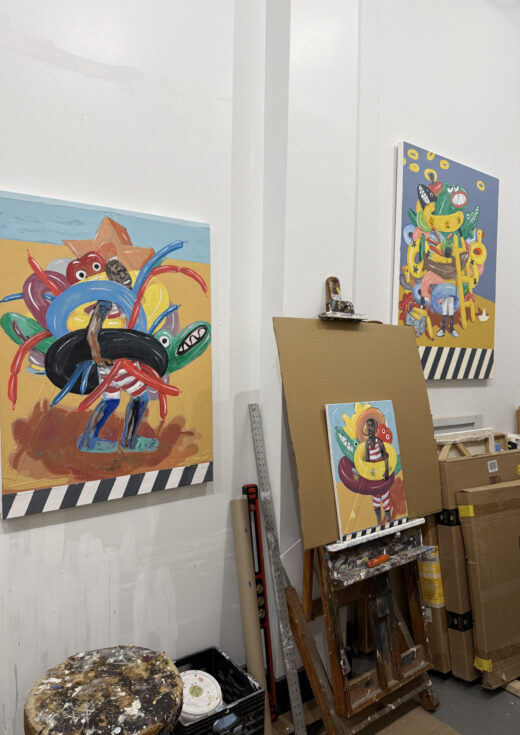
Recent works from Francks in his studio, 2026. Photo by Sofia Minutoli.
Nice. What are you currently working on?
I'm currently exploring the theme of “reclaiming the water.” Reclaiming the water for me represents this process of reconnecting, healing, and cleansing. They say “if you touch the water, you touch the world.” These characters in various different poses and seas and structures—in some cases, what you see is a travel suit made up of inflatable tubes and animals, hearts and shapes—putting all these things together to create a flotation device speaks to my Haitian immigrant experience. This travel that happened in my life, and this cautionary bond of things, raises the question: what happens if you replace an opportunity with hope, or if you replace barriers with opportunities?
All these figures are very energetic, very bright and celebratory to really highlight, this resilience, this determination, this pursuit of happiness. I want to use something that's recognizable to draw the viewer into a conversation that's a little more layered; immigration is a layered subject, in my case in particular. I know a lot of people that didn't want to leave in the first place, and a lot of people that would love to go back. That's the conversation that I want to have, I want to use this kind of friendly, opening remark to have a more difficult or critical conversation about immigration and policy, especially now with this blaming immigrations for all the ills of society, as opposed to bad actors in high positions, making very favorite decisions that only benefits a small group of people, rather than the whole population at large.
It brings up so many issues, but for me, it's really important to kind of really narrow down the starting point according to all these other things. And so the starting point is this very resilient character, ideally how I'd like to think of my inner self in terms of this resilient, determined character who has his eyes set on a particular prize or particular set of accomplishments or a particular target. That target is having this full experience and that happiness, hinging on the ability to have this full experience. I have family and relatives, who are counting down the days when they go back, and when they’ll be able to go back. Haiti right now, my problem is in a lot of turmoil, going on 3 years or so. The sitting president was assassinated, and it’s created a power vacuum that's led to so many other incidences of instability. It has definitely taken its toll.
How do you think you got to that point in your career now where you really can trust yourself and kind of trusting that “thing” and following it? How did you get there?
Trial and era. The ability to trust the process, trust myself, trust my instincts—it was growth, development. Just trial and error, mostly. You sit with a condition long enough, you kind of adjust to it. A lot of it is growth, because there's things happening around you in your youth that you’re completely oblivious to. Fast forward 10 years, 20 years though, when you're more mature, older, more experienced, and reflective, and all of a sudden these things have a whole different gravity to them. A lot came from that, just being able to see the world around me in a fuller picture, as opposed to just this kind of tunnel vision of youth, limitation, and underexposure. I credit a lot of it to just the fortunate times that I've had the fortunate ability to dedicate to this practice for as long as I have. I don't take that for granted.
A lot of people would have given up a long time ago and a lot of people have. For me, it’s not that I've never wanted to give up, but the urge and the desire to continue was always stronger than the desire to give up. For me, it was a lifestyle. Part of my lifestyle is to come to a studio, paint, listen to music, drink wine, hang out with friends, and enjoy the process. Reward the now of it, as opposed to, being discovered when I'm 95 on my deathbed: “great I have a one man show!” That's a trap. I refuse that trap, and this is the path that I've embraced. I've managed to kind of reward myself at the same time, in terms of celebrating the successes and the triumphs and “the now” and treat myself whenever something good happens. If I sell a nice painting, I'll take my kids out to a big dinner and tell them they can have whatever they want. Things like that bring me joy, and they refuel the whole process. This is a symbiotic relationship. Things like that keep you going, you know? It keeps you energized and it makes it easier; if I had to go get a job on the side just to pay for the space, it would be a different experience. But when the space can pay for itself, it's a real treat. That treat is what is one of the things that keeps it going.
I know that you have a background in sociology, and I wonder how that sort of influences the works that you've created and then continued to create.
My background in sociology influenced the work in more of an introspective kind of way, not necessarily in a very literal or direct kind of way. Being in that incubator phase of my life allowed me to really step outside of my immediate reality to have conversations and be exposed to materials that allowed me to take a more cross-examined view on things. So for me, it was about growth and self-development and improving my ability to see things in a more objective light. In the same breath, however, it is very sociological, in terms of practice and observation in some ways; migrations and displacement, this kind of arcing effect of a whole community based on one or two events, or an ongoing event. In some ways there is some parody, but it’s not necessarily deliberate, because that would be giving myself way too much credit. You know, I was just really enjoying creating and I've enjoyed creating as far.
One of my earliest childhood memories. So, you know, I was in a situation where, you know, I was compared next to the older siblings and we were writing script, you know, which is unheard of now that they want prints, if at all, they type it or text. But the fluency of my script, it was overwhelmingly obvious, it was immediately noticeable; like, “wow, how are you so fluid with this lettering, when your older sibling's look like this?” That's something I remember, and I have this very tactile connectivity to the ability to kind of see something and recreate it and draw it and sketch it.
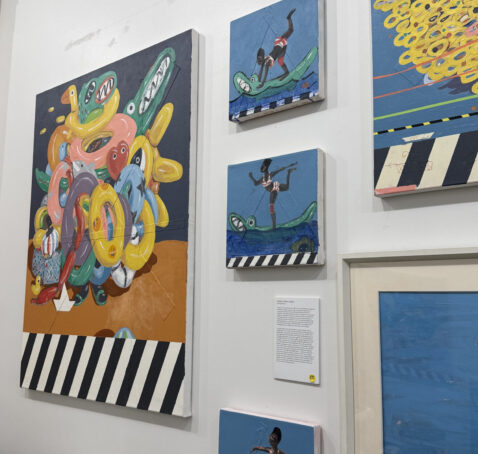
Figures from the theme of "reclaiming the water," 2026. Photo by Sofia Minutoli.
Back to your creativity and how you've been creating for a long time, how do you think that your background in printmaking has influenced the work that you're doing? Or is that also just very inherent?
The printmaking is a very significant part of this whole process because I studied under a few print makers at Robert Blackburn Studio, and that process really got me thinking about my work’s multiples and developing series—amongst some other influencers at the time. It was coming out of printmaking that I realized I can actually take the work to different places, especially in developing a series. Prior to that, I'll probably do one piece here, one piece there, and they’ll all be different formats, but seeing stuff in multiples: it's the same core idea, but it can be reinterpreted in so many different ways. The discipline of it, too, is very arduous in some ways and requires a lot of patience. It's training. It's a discipline. Art making is all of those things: training and discipline, sometimes self-discipline.
Printmaking was definitely instrumental in getting me to see the work in multiples, see the work in different formats, and see what the limitation of color can do too. And so the prints, most of them, are 4 colors; you put 4 colors to the side. Doing that with a painting is a whole different exercise as well; I haven't ever done that with the painting, but I still have the idea. My color is kind of muted for that reason; I tend to use a very muted color palette. Bright, but at the same time, the muted version of it. Why I like that, I don't really know. I don't want the colors to compete with each other, so I'm trying to find ways thatthe colors could all blend together and get along. I guess that's a good social reach of the work, you know, wanting all the colors to get along and compliment, as opposed to working against each other.
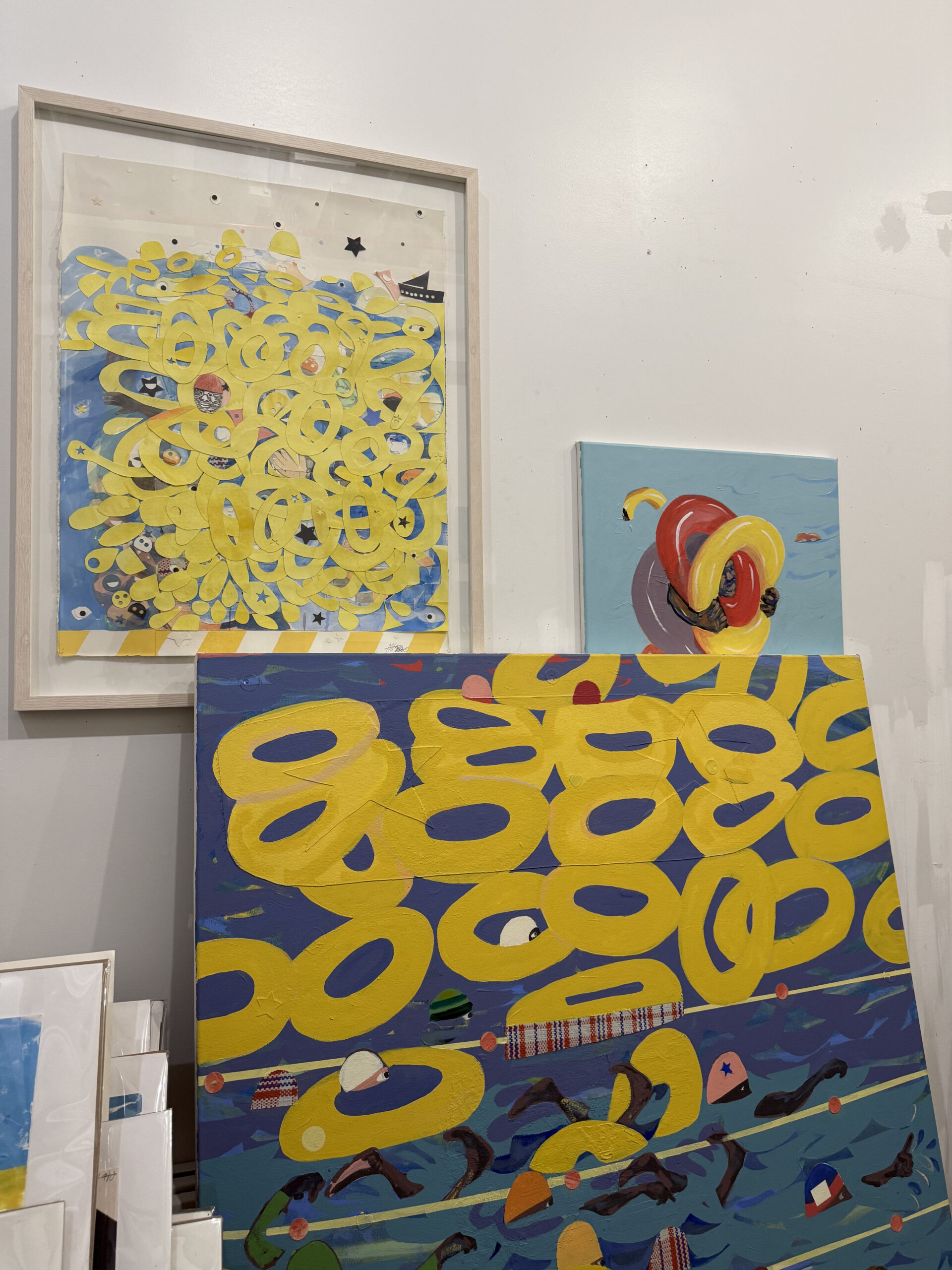
Francks F. Décéus, Carib Olympics (2023), in studio, 2026. Photo by Sofia Minutoli.
Last question. What do you think is next for you? Do you think far in advance when it comes to planning works, or is it very spontaneous in the process?
In terms of the next work, I'm really knee deep into it. I am very energized about it. I have one public project coming up in the next few weeks. Fingers crossed, it'll be up by Memorial Day weekend. Brooklyn Academy of Music, and the Museum of Contemporary African Diaspora Arts (MOCADA) Museum. MoCADA will have a dedication wall on Lafayette, one door over from Brooklyn Academy of Music. So one of these paintings is going to be reproduced into a 30x50 foot mural that's gonna be on that wall for one year. That's the agreement, and I'm looking forward to that project because, one, the timing of it and, two, my own interpretation of it. I see it as me getting some of my flowers. That's been a big thing in the last five to ten years, people getting their flowers, and so, for me, I see that as me getting a bouquet of flowers. Having such a colorful painting reinterprette at the same time, kind of lends itself to that bouquet. Getting an opportunity when you find it enticing is very gratifying; getting opportunities when you feel like you've outgrown it, that's whatever. This is not one of those things. This is one of those things that’s like, “oh yes, let’s please make this happen; please, please, please” kind of a thing. I'm very grateful and looking forward to it.
The director of MoCADA, Amy Hendrix, reached out and said, “this is what we have in mind. I like your work. I would like to get your permission to recreate one of your paintings for this wall, because the current image there is coming down and we need something to replace it. Would you be interested?” And I was like, “yeah, is that even a question? Is that a real question? Why are you even asking?” It's like, “what painting do you want and when do you need it?” That's all you need to tell me.
Fast forward to now, it's finally happening. And I'm definitely looking forward to it. The reasons that I've been, they've been waiting for clear weather because once this thing goes, it needs to really dry. That's where I've been told. So I'm looking forward to that. There are some other shows here, and there but nothing major. I just look forward to continuing the process, and again, for me, this is a lifestyle. It's not based on objectives or finish lines and discovering moments. If that happens, don't get me wrong, I have no objections to any of that, but the reason that I stay at it, at this, is because, you know, this is something I want to do and I've made sacrifices to do it. It wasn't all given or all easy. Life comes and goes, and I live this life that simultaneously keeps us going. Sometimes there were sacrifices, but ultimately, you know, I want to continue to create and explore as long as I can. I'm a very effective man. That's the goal. You know, there are artists in the 80s and the 90s and all of a sudden all these opportunities are coming their way, and they're like, “I can't walk.” That to say there's nothing wrong with getting discovered at a later age, but that shouldn't be the goal. And that's definitely not mine.