Public Women
On July 26th, at the intersection of Mulberry and Grand St, a group of three women in the disciplines of painting, collaging, and dancing find themselves reclaiming the public space for the sake of art and culture; a reminder that art is a human right. Susana Aldanondo, Kanami Kusajima, and Brittany DiMauro came together for “Public Women.” Curated by Aldanondo, the exhibition was crafted for interventions’ sake; to continue the dialogue surrounding women artists in a city, vibrant and well-known for its experimentation.
These women join many of their downtown predecessors who innovated the public space in the 1960s and 70s, including Alison Knowles, Mierle Laderman Ukeles, Sari Dienes, Adrian Piper, Lorraine O’Grady, and many more.
“Public Women” began as DiMauro laid the exhibition posters on the walls of Little Italy and Chinatown. DiMauro, best known for her collage work from discarded magazines, tells stories through her overwhelming and simplistic designs. Every two panels are dedicated to the work of one woman. Aldanondo’s second panel was left blank, later painted live as an abstract figurative piece. Kusajima subsequently joined in with a live painting and improvisational dance.
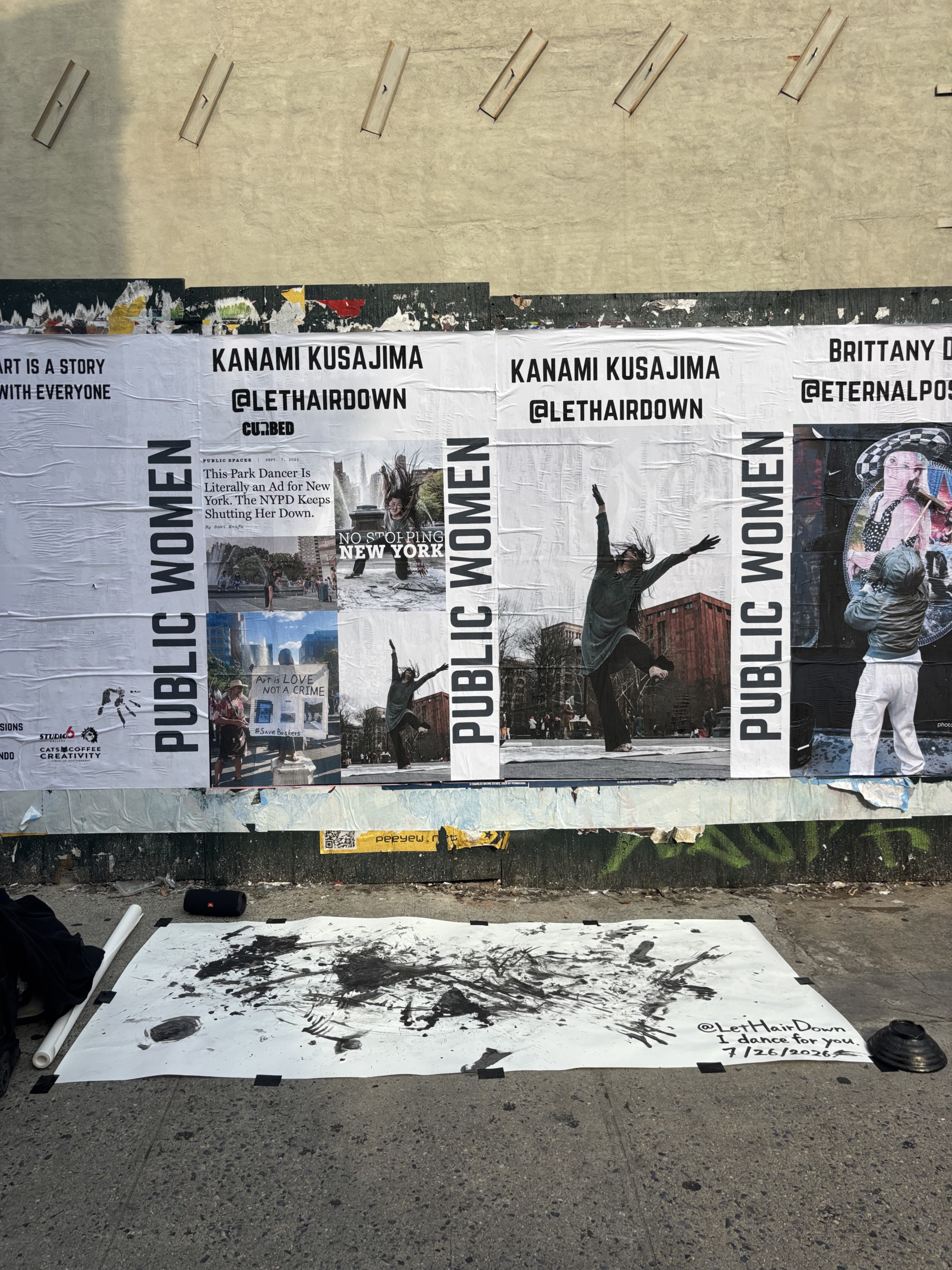
Public Women: An Exhibition, 2026. Photo by Anastasia Mikelis
Aldanondo, best known for her abstract expressionist paintings, explains how “Public Women” is not only a reminder of human rights but a demonstration of them. “I was not only referring to the right to freedom of expression, but specifically to art and access to art, the protection of our works of art as well, which in 1948 were declared a human right and adopted in Paris under the Declaration of Universal Human Rights Act; soon after, adopted by the UN.”
Aldanondo is referring to the Universal Declaration of Human Rights of 1948. Article 27, section 1, states the protection of free participation in the cultural life of the community and the enjoyment of the arts. Section 2 declares the protection of the moral and material interests resulting from artists’ creations.
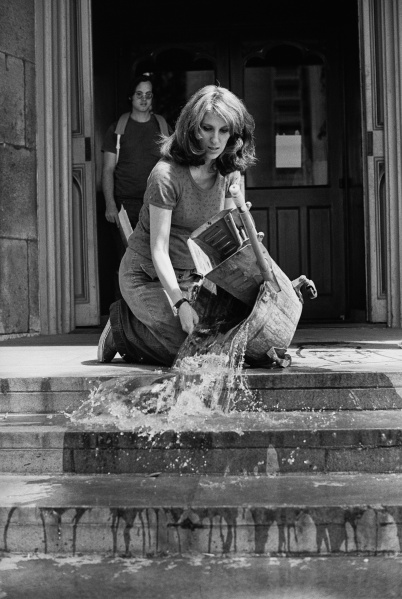
Mierle Laderman Ukeles, Washing/Tracks/Maintenance: Outside, 1973
Public Women: Of the Past
Women in the public space emerged as the conceptual art movement expanded and Fluxus came to fruition. Women like Adrian Piper fought to be known in conceptual circles. She was a philosopher and grid artist, a friend of Sol LeWitt. Her performance pieces Catalysis III, 1970, and Mythic Being, 1973, test systemic expectations versus internal and external reactions.
Footage of Catalysis III records the reactions of Piper standing in the middle of the sidewalk wearing a "Wet Paint" sign. Mythic Being captures Piper disguised as a man, repeating a line aloud. People stared out of curiosity, a fascination with the strange and the self. Piper was experimenting with the camera to record public reaction, drawing people in. The experiment evoked a reaction, registering human behavior. This type of performance art exemplifies how public space can be a means of connection for the community.
Mierle Laderman Ukeles is another woman who performed in public space. Her piece Washing/Tracks/Maintenance: Outside, 1973 reflects second-wave feminism that advocated for the female body, domesticity, women in the workforce, and women at home. Ukeles found herself at the crux of being an artist and a mother, feeling she had to choose between maintaining motherhood and her career. She takes inspiration from the abstract expressionists and the art of the "gesture." From this, she turns the gesture of maintenance and labor into art. In this piece, Ukeles is scrubbing the steps of the Wadsworth Atheneum Museum of Art. Her performance draws attention to the museum workers who maintain the museum's interior, yet are overwhelmingly overlooked for their contributing role to the museum's outward appearance. The Wadsworth Atheneum was the only museum that accepted her offer to perform the four cleaning tasks.
Piper and Ukeles' determination and performance in the public space are interventions for the public, continuing the dialogue surrounding art. What is art? What is not art? Is art less valuable in the public space? These women artists provoke people to think critically about their behavior. Their work is an obstruction of the social order and a critique of the untouchable qualities formed by institutional standards.
Public Women Today
Kanami Kusajima, the dancer, choreographer, and performing artist, also known as “Let Hair Down,” gained visibility during COVID, in person and online, from her performances in Washington Square Park. When asked what she feels as she is performing, she stated, “I feel all different kinds of energy from everything in the space. From the people, from the street, from nature, and from my internal senses, both in my body and mind- all of the surroundings affect my movement as well as my inner sensations. And the painting I create during the performance is a reflection of all of them.”
As Kusajima danced, a crowd began to form. Both adults and children alike were magnetized by her movements, stopping for a few seconds or even minutes. “Public Women” shows people that the preconceived notions they have of art, ones that find home in the white cube, don't exist in isolation. The public space welcomes all artists; however, the general public may not. Many questions arose about what she was doing; one woman even stated, “This isn’t art." As a student of Art History, this only proved to me the necessity of the exhibition, to expand the perception of art.
Elite expectations, perhaps, skew the societal notions of the general public about the art world. Often, there is a physical and monetary gap between art and the viewer that may lead to the belief that art is not meant to be accessible, or that it is literally untouchable. “Public Women” challenges fixed, preexisting ideas of art as well as the strain that these ideas place on artists' creative processes.
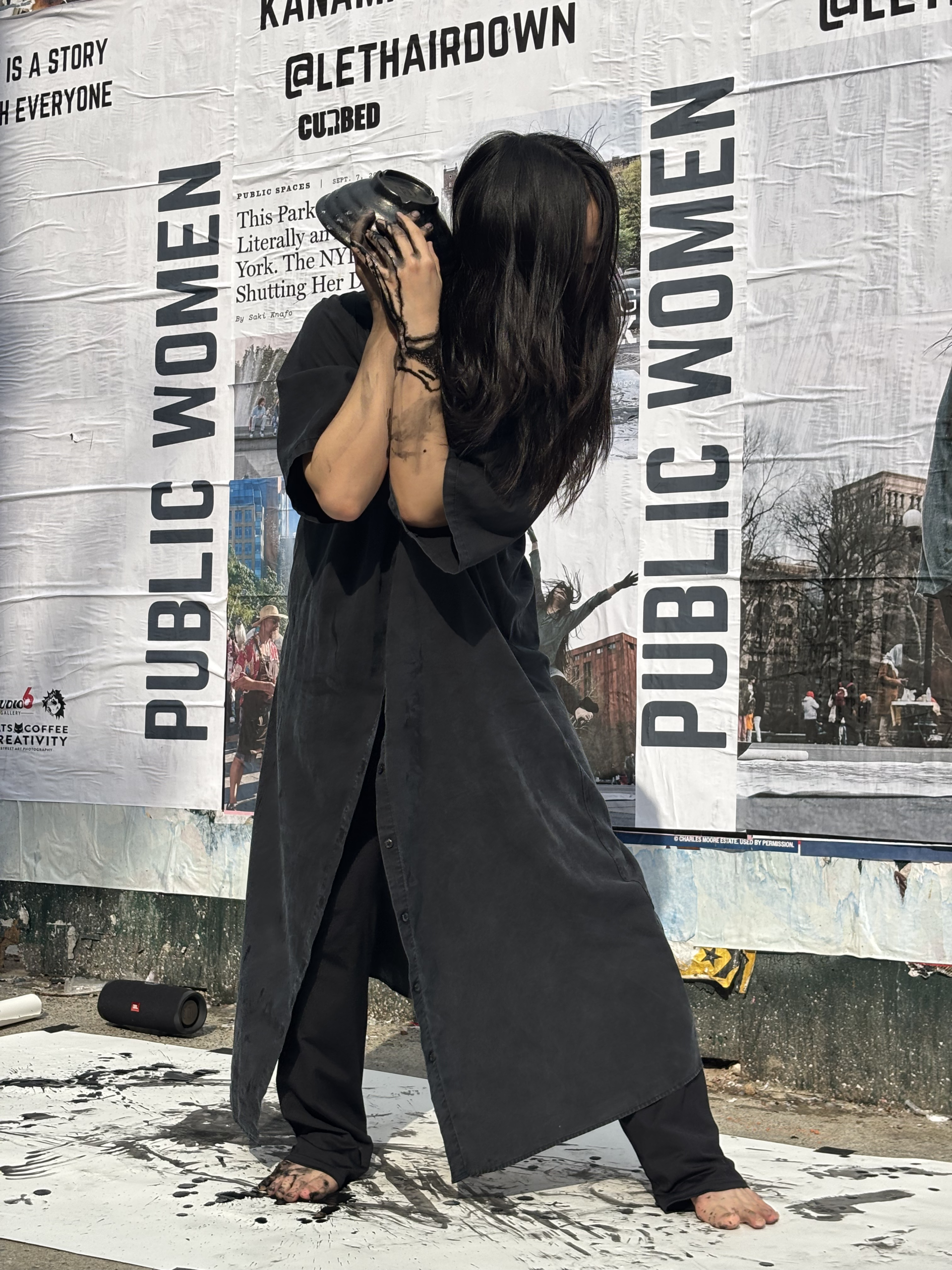
Kanami Kusajima live painting and improvisational dance, 2026. Photo by Anastasia Mikelis
DiMauro states, "I think a common misconception about public art is that we have support from institutions when in reality many of us are self-funded and unsanctioned. I think this judgement exists, particularly as it pertains to street art because most people cannot wrap their heads around taking action outside the bounds of commerce. Even the police have asked me, 'Are you getting paid for this?' Unfortunately, in today's art world, much is driven by the desire to be famous rather than the desire to connect."
Aldanondo furthers this point by explaining the challenges she has faced, claiming, “The organizations in charge of distributing funds to make the arts equitable and lead in creating a more balanced art world act as gatekeepers, posing obstacles: lengthy applications, placing expectations and value on who an artist already is, what achievements they already have, etc. They act like the big galleries. Most artists have very few opportunities and nearly no access to spaces to create or display their work. The reality in New York alone is that about 80% of shows are given to white males. When it comes to highlighting women artists, the realities of exclusion and lack of opportunities are very real.”
Why Public Art?
A reasonable presumption is that working in the public arts brings about challenges. In the face of adversity, these women continue to work despite the obstacles, but why? It's the principle. Art and culture are meant to be enjoyed by everyone. Bringing art into the community gives back and allows others to be present and appreciative of the profession. Seeing artists come together in the community to share their work is uplifting and powerful; their unity brings the work alive. As Kusajima so eloquently says, an artist's surroundings affect their art. Art is a reflection of the artists' endurance and experience. Susana Aldanondo, Brittany DiMauro, and Kanami Kusajima join the women in the public space who have made their mark on the public arena.
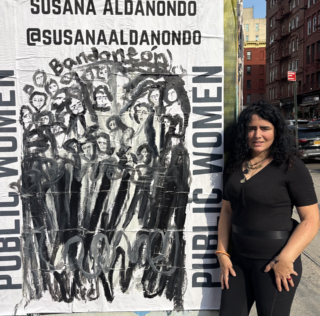
Portrait of Susana Aldanondo and Painting.
(@susanaaldanondo)
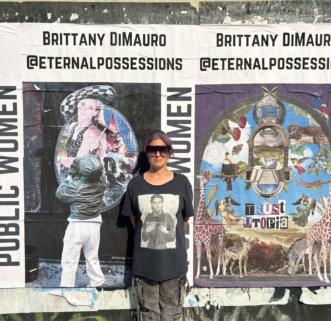
Portrait of Brittany DiMauro and Collages.
(@eternalposessions)
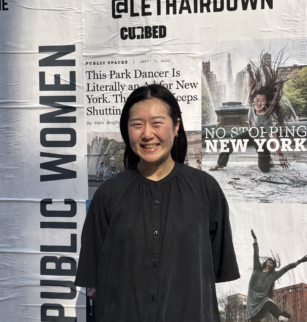
Portrait of Kanami Kusajima.
(@lethairdown)